Meningococcal Meningitis: What It Is and Why It’s Serious
Meningococcal meningitis is a serious bacterial infection of the meninges – the protective membranes around the brain and spinal cord – caused by the bacterium Neisseria meningitidis. It can lead to severe complications like brain damage or hearing loss, and can be life-threatening if not treated promptly.
The infection spreads person-to-person via respiratory droplets or throat secretions (for example, through coughing, sneezing, or kissing). This means it can pass quickly in close quarters or crowded settings. Anyone can contract it if exposed, though it’s not as contagious as the flu or cold.
Meningococcal disease can progress rapidly. Even with proper antibiotic treatment, about 10–15% of infected people do not survive. Among those who recover, as many as 1 in 5 are left with permanent after-effects – such as neurological damage, loss of hearing, or limb amputations. This underscores how severe the illness can be.
The good news is that meningococcal meningitis is largely vaccine-preventable. Many countries include meningococcal vaccines in their routine childhood immunization schedules, providing early protection against common strains. For instance, in Canada infants receive a meningococcal C vaccine, and adolescents are given a quadrivalent MenACWY vaccine. Being vaccinated greatly reduces one’s risk of contracting this disease.
Should You Get a Meningitis Vaccine Before Traveling?
Plan a pre-travel health consultation: It’s wise to visit a travel health clinic or your doctor 6–8 weeks before your trip to discuss which vaccines you might need. A healthcare professional can assess your itinerary and medical history to determine if the meningococcal vaccine is recommended for you.
Not all travelers need this vaccine, but…: Meningitis vaccination isn’t required for every destination – most travelers are at low risk. However, experts do recommend it for certain trips and situations. If you’re headed to a region where meningococcal disease is more common, or an area currently experiencing an outbreak, a meningitis shot is an important precaution.
Examples of higher-risk travel: If, for example, you plan to visit a country in the African meningitis belt during the peak season or an active epidemic, getting the quadrivalent MenACWY vaccine before you go is strongly advised. Similarly, travelers undertaking activities that involve close contact with local populations (such as volunteering in rural communities or attending large festivals) should consider vaccination. In short, discuss your specific plans with a travel health adviser – they will recommend the meningococcal vaccine if your trip warrants the extra protection.
Travel Requirements: When You Need a Meningitis Vaccination Certificate
Mandatory for Hajj and Umrah (Saudi Arabia): Certain destinations require proof of meningococcal vaccination. Notably, Saudi Arabia mandates an official vaccination certificate for all travelers aged 1 year and older who are entering for the Hajj or Umrah pilgrimages (or for seasonal work in the Hajj region). In these cases, getting the vaccine isn’t just for personal safety – it’s a legal entry requirement.
Timing and validity of the vaccine: To meet Saudi Arabia’s rules, you must receive the quadrivalent meningococcal (ACWY) vaccine at least 10 days before arrival. The certificate is valid for up to 5 years after vaccination (when a conjugate vaccine is used). This means if you had the shot more than 5 years ago and are traveling again, you’ll need a booster and a new certificate. (Older types of the vaccine are valid for a shorter period, but current vaccines given by clinics are typically the long-lasting conjugate type.)
Carry the proof with you: When you get a travel meningitis vaccine, the clinic or doctor will provide you with an official vaccination record or certificate. Make sure to carry this document during travel, as you will be asked to show proof of vaccination upon entry to countries like Saudi Arabia. It’s wise to keep the certificate with your passport or travel papers. (If you get vaccinated at a travel clinic, they’ll know the documentation required and will fill it out for you.)
Global Meningitis Risk Zones: The African “Meningitis Belt” and Beyond
The African “meningitis belt” (dark blue region on the map) spans 26 countries from Senegal in the west to Ethiopia in the east, where meningococcal disease incidence is highest. Outbreaks in this region occur most frequently during the dry season (roughly December through June). Climate factors like dry, dusty winds are thought to contribute to these seasonal epidemics, as they irritate nasal passages and potentially facilitate the spread of the bacteria.
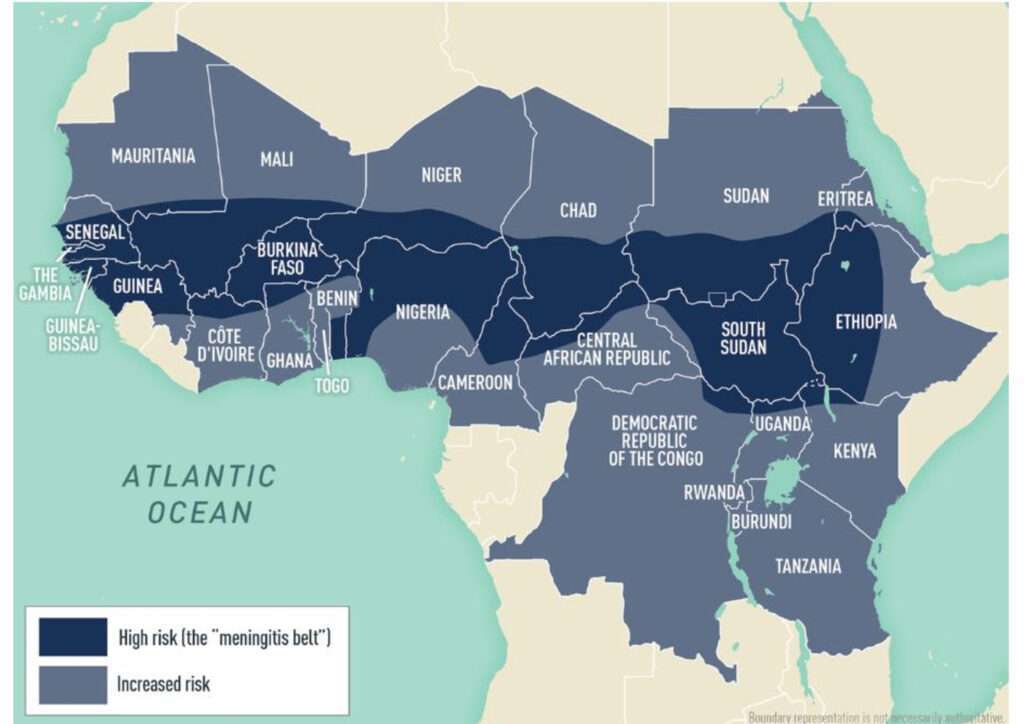
Africa’s high-risk region: The African meningitis belt has historically suffered explosive epidemics of meningococcal meningitis. Before 2010, serogroup A meningitis caused devastating large outbreaks here every few years. Mass vaccination campaigns (for example, the introduction of the MenAfriVac conjugate vaccine) have now virtually eliminated meningitis A epidemics in this belt. However, other strains (like serogroups C, W, X, etc.) still circulate and can spark outbreaks, so the region remains a focus of meningitis prevention efforts. Travelers to this part of Africa should be particularly aware of the risk.
Meningitis risk around the world: Outside of sub-Saharan Africa, meningococcal disease is less common, but it exists worldwide at lower levels. Industrialized regions (Europe, North America, Australia, etc.) see only isolated cases or small clusters (often 0.1–2 cases per 100,000 people per year in those areas, versus up to 1000 per 100,000 during African outbreaks). In temperate climates, cases tend to peak in the winter months, whereas in tropical regions, the risk rises during the dry season. While large-scale epidemics are rare in most countries, localized outbreaks can occur anywhere – so it’s always good to stay informed about your destination (more on that below).
Which Travelers Face a Higher Risk of Meningitis?
Those traveling during an outbreak: The average traveler has a very low chance of getting meningitis. But if you happen to be in a place during a meningococcal outbreak, your risk increases significantly. Travelers heading to a region known to have an ongoing epidemic or recent cluster of cases should be extra cautious (and will likely be urged to vaccinate before departure).
People with certain health conditions: Travelers with weakened immune systems or specific medical conditions are more vulnerable. For example, someone who lacks a functioning spleen or has a complement immune deficiency has a higher susceptibility to meningococcal infection. If you have an underlying condition (such as HIV or other immunosuppression), discuss meningitis protection with a doctor – this vaccine is often recommended for you, even if other travelers in your group might not need it.
Age groups that are more vulnerable: Meningococcal disease doesn’t affect all ages equally. Infants and young children have the highest rates of infection, and there’s another peak in adolescents and young adults (late teens to early 20s, which is around college age). The risk also rises again in older adults (elderly people), whose immune systems may not respond as robustly. So, a young backpacker or an elderly tourist might be at slightly higher risk than a middle-aged traveler, for instance – one reason youth travelers and seniors should ensure they’re up to date on vaccines.
Travelers in high-exposure situations: Certain types of travel put people in closer contact with the bacteria. If you’re visiting friends and family in an area where meningitis is common, you’ll be mixing with the local population more intimately and could be more exposed (this is known as the “VFR” – visiting friends and relatives – risk). Healthcare or aid workers traveling to regions with meningitis are also at higher risk due to potential close contact with patients. Additionally, anyone spending time in crowded or closed settings is more exposed – think of pilgrims in packed accommodations, students in dormitories, or attendees of large festivals. Big gatherings can facilitate the spread of meningococcal disease. so travelers partaking in such events should be mindful of meningitis risks and prevention.
Booster Vaccines: Maintaining Meningitis Protection
Immunity wanes over time: Getting the meningococcal vaccine confers good protection, but it doesn’t last forever. The protective effect is estimated to last around 5 years for the MenACWY conjugate vaccine. After this period, your antibody levels may drop enough that you’re no longer well-protected. This is important if you were vaccinated a long time ago – you might not be as immune now as you think.
Get a booster if it’s been over 5 years: If it’s been more than five years since your last meningitis vaccination and you’re traveling to an area of risk, you should get a booster shot before you go. A booster is basically an extra dose given to refresh your immunity. Travel health guidelines advise a repeat meningococcal vaccine every 5 years for people who continue to be at risk (for example, someone who lives in or frequently travels to the meningitis belt). This ensures that your protection stays strong over time.
Stay current for recurring travel: Even if a country only requires the vaccine every five years for entry, consider your personal safety as well. If you got the shot for a trip a number of years ago and now plan to visit a high-risk region again, don’t assume you’re still protected – a quick booster can extend your immunity. The MenACWY vaccine booster is safe and generally well-tolerated (side effects are usually mild, like a sore arm), so there’s little downside to updating it. Keeping your meningitis vaccination up to date is a smart precaution for serial travelers.
Staying Informed: Checking for Meningitis Outbreaks Before Travel
Consult travel health professionals: Travel medicine clinics and specialists keep close tabs on current outbreaks worldwide. If you’re unsure about the meningitis risk for the place you’re visiting, ask an expert. They can provide up-to-date insight, including whether any meningitis cases have been reported recently or if any new vaccine recommendations have emerged. This personalized advice is especially useful for remote or rapidly changing situations that might not make the news. Remember, outbreak conditions can evolve – what was safe a month ago could change, so get the latest information before you go. And if there is an elevated risk, you’ll be glad to be informed so you can take precautions (like getting vaccinated or avoiding certain high-risk activities) during your travels.