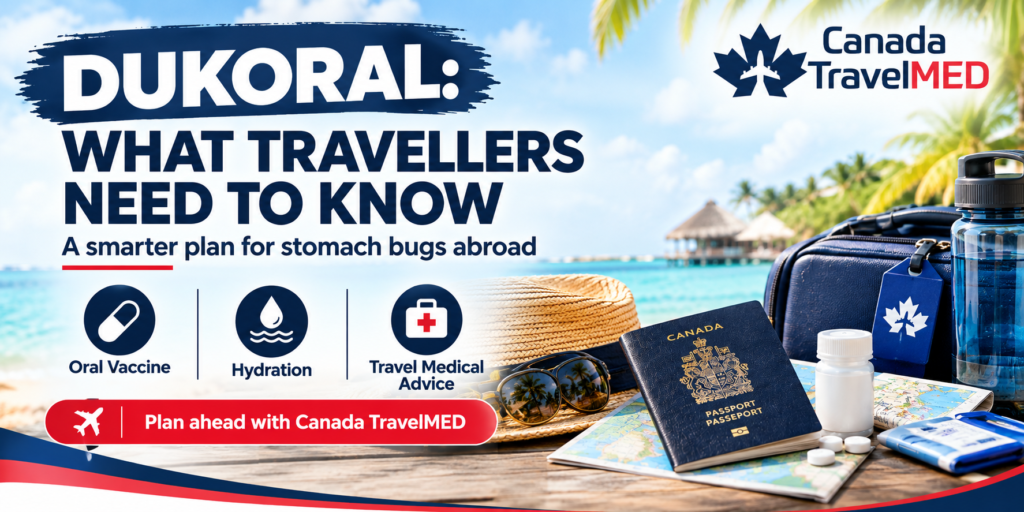
For most healthy travellers heading to a five-star resort in Mexico or the Dominican Republic, Dukoral offers limited overall protection—preventing roughly 6% of all-cause travellers’ diarrhea—making a personalized gastrointestinal plan and a prescription standby antibiotic from a virtual travel clinic Ontario provider a far more reliable investment.
You have the swim-up bar booked, your passport is finally renewed, and the out-of-office reply is drafted. Then someone at the office mentions a horror story about spending four days of a seven-day Cancun trip locked in the hotel bathroom, and suddenly you are frantically searching whether you need to drink two doses of a fizzy vaccine before boarding the plane. When you only have a week or two before departure, trying to book an appointment at a brick-and-mortar clinic feels like a part-time job.
Instead of sitting in a crowded waiting room just to get a generic sales pitch, you can build a complete, medically sound digestive and travel health strategy from your living room. This guide breaks down the actual clinical numbers behind Dukoral, explains why travel health is about a full preventative system rather than a single box from the pharmacy fridge, and shows how booking an affordable virtual consultation with Canada TravelMED sets you up with destination-specific prescriptions, malaria prophylaxis, and emergency diarrhea kits sent straight to your local pharmacy.
Planning an Upcoming Trip Abroad?
Get destination-specific health guidance, vaccine prescriptions, and travel advice from our licensed healthcare team—all online with Canada TravelMED.
Book Your Consultation100% Virtual Consultation Available • Accepted Across Canada
Key Takeaways
- The Clinical Reality of Dukoral: While Dukoral is highly effective against cholera, it only targets one specific strain of E. coli (heat-labile toxin-producing ETEC), resulting in an overall efficacy of roughly 6% against all causes of travellers’ diarrhea.
- Standby Antibiotics Often Win on Value: For healthy resort-goers, carrying a prescribed standby antibiotic (such as azithromycin) alongside oral rehydration salts treats moderate-to-severe bacterial infections rapidly if symptoms actually strike, rather than gambling on narrow preventative coverage.
- Who Should Still Take Dukoral: Travellers with underlying medical conditions—including insulin-dependent diabetes, inflammatory bowel disease, chronic kidney disease, heart failure, or compromised immune systems—as well as those taking acid-suppressing medications, benefit from every extra layer of protection.
- Timing Matters for Last-Minute Trips: A primary Dukoral series requires two oral doses taken at least one week apart, with the second dose completed seven days before departure. If your wedding or getaway is less than two weeks away, you cannot complete the series in time.
- Skip the Waiting Room: An affordable Canada TravelMED virtual consultation gets your custom preventative plan and prescriptions sent directly to your pharmacy the same day. We also provide ongoing in-trip video support via SnapMED if you fall ill abroad.
The Dukoral Misconception
Roughly 30% to 40% of Canadian vacationers bound for Mexico and the Dominican Republic develop traveler’s diarrhea. Clinical trials show 35% of Dukoral-vaccinated travellers still get sick, compared to 37% of unvaccinated travellers. That narrow 2% margin explains why the routine pre-trip pharmacy purchase is one of the most misunderstood investments in travel medicine.
Vacationers often assume drinking a quick oral vaccine before flying south provides bulletproof protection against tainted resort water and buffet ice. The biological reality is far more specific. While the vaccine targets one specific bacterial toxin, resort outbreaks are triggered by dozens of different bacteria, viruses, and parasites. Knowing whether to spend your money on an over-the-counter oral vaccine or to book an affordable gastrointestinal travel health consultation for prescription standby antibiotics is the difference between salvaging a seven-day holiday in 12 hours or losing four days confined to a hotel room.
- Targeted Bacterial Scope: Dukoral protects strictly against Vibrio cholerae (cholera) and a single subgroup of Enterotoxigenic E. coli (ETEC).
- Limited Overall Prevention: Because ETEC accounts for roughly one-third of Caribbean and Latin American diarrhea cases—and only about 60% of those strains produce the specific heat-labile toxin—overall real-world protection against all-cause resort stomach bugs hovers around 20% to 25%.
- Out-of-Pocket Costs: A two-dose primary series costs between $110 CAD and $140 CAD at Canadian pharmacies. Conversely, a prescription antibiotic paired with an antimotility agent costs $25 CAD to $45 CAD prior to private insurance reimbursement.
- High-Risk Exceptions: The vaccine remains highly valuable for travellers with inflammatory bowel disease, suppressed immune systems, chronic kidney disease, or those taking daily acid-suppressing proton pump inhibitors.
- Rapid Standby Relief: Targeted prescription antibiotics like azithromycin or rifaximin halt moderate-to-severe bacterial infections across multiple species within 12 to 24 hours after symptoms begin.
How Does Dukoral Work? (ETEC vs. Cholera Explained)
To figure out if an oral vaccine is worth $50 CAD to $80 CAD per person out of pocket, you have to look at what is actually making travellers sick at the buffet.
Travellers’ diarrhea is not caused by a single germ. It is an umbrella term for acute digestive infections triggered by a wide variety of bacteria, viruses, and parasites. According to the Public Health Agency of Canada Dukoral Guidelines, Enterotoxigenic Escherichia coli (ETEC) is the most common bacterial culprit in Latin America and the Caribbean, accounting for roughly 25% to 50% of cases.
The Catch with Heat-Labile Toxin (LT)
ETEC bacteria make you sick by producing two different types of toxins in your gut—a heat-labile toxin (LT) and a heat-stable toxin (ST). Some strains produce only LT, some produce only ST, and some produce both.
Dukoral is an inactivated oral vaccine originally engineered to prevent cholera (Vibrio cholerae serogroup O1). Because the cholera toxin is structurally very similar to the heat-labile toxin (LT) produced by certain E. coli strains, the antibodies your gut builds after drinking Dukoral cross-react and neutralize LT-producing ETEC.
- What Dukoral blocks: Vibrio cholerae O1 (around 85% efficacy) and ETEC strains that produce LT (60% to 67% efficacy against that specific subgroup).
- What Dukoral misses completely: ETEC strains that only produce ST, plus every single case of Salmonella, norovirus, and parasitic waterborne infections.
Canada’s tropical medicine advisory committee (CATMAT) evaluates all pathogens circulating across resort destinations. Under this broader view, Dukoral’s protection against traveler’s diarrhea falls to merely 6% to 25%, depending on the microbial mix.
The Dosing Schedule Hurdle
Even if you want that extra margin of protection, the calendar is often the dealbreaker. For a first-time adult user, Dukoral requires two liquid doses mixed with an effervescent buffer solution:
- Dose 1: Taken at least two weeks (14 days) before you fly.
- Dose 2: Taken at least one week after the first dose, and at least seven days before your departure.
- The Fasting Rule: You cannot eat, drink (even water), or take any oral medication for one hour before and one hour after drinking each dose. The reason behind this is because stomach acid destroys the vaccine components.
If you are booking a last-minute sunshine deal or flying down for a destination wedding in ten days, your body simply will not have time to finish the series and build mucosal immunity before you hit the taco station.
Why Choosing a Virtual Travel Clinic Ontario Service Beats the Waiting Room
Traditionally, figuring out your resort medications meant taking half a day off work, driving across town—whether you live in Hamilton, Burlington, or Brantford—paying for parking, and sitting in a sterile clinic waiting room alongside coughing patients. Worse yet, many brick-and-mortar travel clinics operate like retail stores: they stock vaccines in their own fridges and have a financial incentive to sell you every possible box on the shelf, regardless of whether your itinerary genuinely warrants it.
Working with a virtual travel clinic Ontario team flips that experience around completely. At Canada TravelMED, our physicians have seen firsthand how preventable health crises—from severe foodborne bacterial infections to contaminated ice and unrecognized parasites—can derail a dream trip and land Canadians in unfamiliar foreign hospitals. Our core philosophy is Prevention, Not Just a Prescription. Travel medical insurance is there to pay the bill after you are admitted to a clinic in Punta Cana; our job is to keep you out of that hospital bed in the first place.
The Same-Day Virtual Advantage
When you book a low-cost virtual consultation with our medical team, the entire risk assessment happens from your couch or kitchen table:
- No Retail Upselling: Because we do not sell physical boxes of vaccines out of a clinic lobby, you get unbiased, evidence-based clinical advice. If you do not need a specific shot or drinkable vaccine for your resort, our doctors will tell you straight up.
- Direct-to-Pharmacy Prescriptions: Once your personalized travel health plan is finalized, we transmit your prescriptions electronically to your regular neighbourhood pharmacy anywhere in Canada—from Oakville and Kingston to rural towns across the province. Many pharmacies can administer your routine injections right on site.
- Affordable Care & Low-Cost Follow-Ups: Unlike specialized private medical clinics (such as private dermatology or concierge clinics that charge steep fees at every touchpoint), our consultations and follow-up check-ins are purposefully kept low-cost and accessible. Plus, our consultation receipts and prescribed vaccines or medications are frequently eligible for reimbursement under private employer extended health plans or Health Spending Accounts (HSAs).
- In-Trip Support via SnapMED: Health emergencies rarely wait for Monday morning office hours. Because our clinic integrates seamlessly with SnapMED video services, you can connect with our medical team virtually while you are on your trip if you develop symptoms and need real-time guidance on when to start your emergency medication.
Dukoral vs. Standby Antibiotics: Building a Real Gastrointestinal Defence Plan
If drinking a two-dose cholera vaccine isn’t a silver bullet for the resort buffet, how do seasoned travel doctors actually protect their patients? By building a layered gastrointestinal defence kit tailored to your health history.
1. The Power of the Standby Antibiotic Kit
Instead of spending $75 CAD per person trying to block a single sub-strain of E. coli before you leave, our physicians frequently prescribe a targeted traveller diarrhea emergency kit to pack in your carry-on.
When you have a pre-filled course of a destination-appropriate antibiotic—such as azithromycin (which works rapidly against invasive bacteria like Campylobacter, Shigella, and severe ETEC without the tendon-related side effects or regional resistance issues seen with older drugs like ciprofloxacin)—you have a decisive clinical tool in your toiletry bag.
If you experience mild stomach rumbling from rich food or a change in water minerals, you manage it with hydration and bismuth subsalicylate. But if true moderate-to-severe bacterial diarrhea hits with fever, cramping, or incapacitating urgency, taking your prescribed standby medication alongside oral rehydration salts typically halts the infection within 24 hours. You lose an afternoon by the pool instead of losing your entire vacation.
2. High-Risk Patients Who Should Take Both
This is where personalized medicine matters most. While a healthy 35-year-old might skip Dukoral in favour of a standby kit, certain travellers cannot afford any bout of dehydration without risking a serious medical cascade. During your Canada TravelMED gastrointestinal consultation, our doctors strongly consider layering Dukoral plus a standby treatment plan for:
- Patients on Acid Blockers: If you take daily proton pump inhibitors (like omeprazole or pantoprazole) for acid reflux, your stomach lacks the natural acid barrier that kills swallowed bacteria, making you significantly more vulnerable to ETEC.
- Diabetics & Renal Patients: Even 12 hours of severe fluid loss can trigger dangerous blood sugar spikes, ketoacidosis, or acute kidney injury in travellers with diabetes or chronic kidney disease.
- Inflammatory Bowel Disease (IBD) & Immunocompromised Travellers: A routine gut infection in Mexico can trigger a month-long Crohn’s or ulcerative colitis flare-up, or cause severe systemic illness in cancer patients and those on immunosuppressants.
- Pregnant Travellers & Older Adults: Managing dehydration and medication safety during pregnancy or in older age requires careful, proactive pre-trip planning.
- Zero-Downtime Travellers: If you are the bride or groom at a destination wedding, a keynote speaker, or an athlete competing abroad, paying $60 CAD to reduce your ETEC risk by even a modest percentage is often well worth the peace of mind.
Beyond the Buffet: Vaccines and Malaria Prophylaxis for Resort Travellers
One of the biggest misconceptions about all-inclusive travel is that staying inside a gated resort complex makes you immune to local infectious diseases. Mosquitoes do not check wristbands at the security gate, and kitchen staff commute daily from surrounding communities.
When you meet with a travel clinic Ontario specialist at Canada TravelMED, we look at your specific resort region, planned excursions, and vaccination records to cover three critical pillars beyond travellers’ diarrhea:
1. Hepatitis A and Typhoid Fever
Hepatitis A is a viral liver infection spread through contaminated food, ice, shellfish, or raw produce handled by an infected worker—even at luxury five-star properties. A single dose before departure provides high-level short-term protection, and a booster six months later locks in immunity for decades. If you plan to leave the resort for street food tours, cenote excursions, or rural visits in Mexico, Central America, or South Asia, adding an oral or injectable Typhoid vaccine is essential.
2. Malaria Prophylaxis for Specific Resort Zones
While Cancun and Los Cabos carry negligible malaria risk, other popular sun destinations—including parts of the Dominican Republic (especially provinces bordering Haiti or rural excursion areas outside Punta Cana), parts of Central America, and sub-Saharan Africa—require targeted mosquito strategies. Depending on your exact resort map and day trips, our doctors can prescribe well-tolerated anti-malarials like atovaquone-proguanil (Malarone) and guide you on DEET or picaridin insect repellents to prevent dengue fever, Zika, and chikungunya.
3. Routine Boosters and Yellow Fever Certification
International airports and resorts are global mixing bowls for respiratory viruses. We verify that your routine tetanus-diphtheria-pertussis (Tdap) and measles-mumps-rubella (MMR) shots are up to date, and advise on yellow fever certification requirements if your itinerary includes South American or African transit hubs.
Comprehensive Ontario Travel Medication & Vaccine Reference Chart
Check this guide to verify Ontario pricing, clinical timelines, and Health Canada DINs before contacting your insurer or pharmacy.
| Medication / Vaccine Brand | Target Disease | Estimated Ontario Pharmacy Cost (CAD) | Required Dosing Timeline | Health Canada DIN |
| Twinrix (Adult) | Hepatitis A & Hepatitis B | $80 to $95 per dose (plus dispensing fee) | Standard: 0, 1, and 6 months. Rapid: Days 0, 7, and 21 before departure, with a booster at 12 months | 02230578 |
| Twinrix Junior | Pediatric Hepatitis A & Hepatitis B | $55 to $70 per dose | Standard: 0, 1, and 6 months | 02237548 |
| Havrix 1440 / Avaxim | Hepatitis A | $65 to $85 per dose | 1 dose at least 2 weeks before departure; booster at 6 to 12 months for long-term immunity | 02187078 (Havrix) / 02237792 (Avaxim) |
| Engerix-B | Hepatitis B | $45 to $65 per dose | 3 doses at 0, 1, and 6 months (accelerated schedules available) | 01919431 / 02487039 |
| Typhim Vi (Injectable) | Typhoid Fever | $55 to $75 per dose | Single injection at least 2 weeks prior to departure; lasts 2 to 3 years | 02130955 |
| Vivotif (Oral Capsules) | Typhoid Fever | $55 to $70 per box (4 capsules) | 1 capsule taken every other day (Days 1, 3, 5, and 7), finished at least 1 week before travel | 00885975 |
| Vivaxim | Combined Hepatitis A & Typhoid Fever | $125 to $150 per dose | Single injection at least 2 weeks before departure | 02248361 |
| Dukoral (Oral Drink) | Cholera & ETEC Traveller Diarrhea | $95 to $115 per 2-dose kit | 2 oral doses taken 1 week apart, completed at least 1 week prior to travel | 02247208 |
| YF-Vax | Yellow Fever | $170 to $210 per dose | Single injection at least 10 days before entering an endemic country (official certificate valid for life) | Government of Canada Yellow Fever Guide / 00428833 |
| Ixiaro | Japanese Encephalitis | $220 to $260 per dose (2 doses required) | Standard: Days 0 and 28. Accelerated (adults 18 to 65): Days 0 and 7, finished 1 week before travel | 02333279 |
| Imovax Rabies / RabAvert | Rabies (Pre-Exposure) | $225 to $270 per dose | 2-dose or 3-dose series depending on risk profile (Days 0, 7, and 21 or 28) | 01908286 (Imovax) / 02267667 (RabAvert) |
| Ixchiq | Chikungunya Virus | $210 to $245 per dose | Single intramuscular injection at least 2 weeks before travel | 02548984 |
| Nimenrix | Meningococcal Disease (A, C, W-135, Y) | $130 to $160 per dose | Single injection at least 2 weeks before travel (mandatory for Hajj and Umrah pilgrims) | 02402904 |
| Malarone (Adult 250mg/100mg) | Malaria Prophylaxis | $6.50 to $8.50 per tablet ($3.50 to $4.50 generic) | Daily tablet starting 1 to 2 days before entering malaria zone, daily during stay, and 7 days after leaving | Government of Canada Malaria Notice / 02238151 |
| Doxycycline (100mg) | Malaria Prophylaxis | $1.00 to $2.00 per tablet | Daily tablet starting 1 to 2 days before entering risk zone, daily during stay, and 28 days after leaving | 00868965 |
| Azithromycin (250mg) | Standby Traveller Diarrhea Treatment | $25 to $40 per course | Taken only if moderate-to-severe bacterial diarrhea develops abroad (1 to 3 day course) | Public Health Agency of Canada Traveler’s Diarrhea / 02265826 |
| Acetazolamide (250mg) | Acute Mountain / Altitude Sickness | $20 to $35 per prescription | Twice daily starting 24 hours before ascending above 2,500 metres |
Understanding Ontario Travel Vaccine Costs and Dispensing Fees
When you fill a travel prescription in Ontario, the total cost at the pharmacy counter consists of two primary elements: the retail medication cost and the standard professional dispensing fee.
Most community pharmacies add a standard dispensing fee to cover inventory management, safety checks, and pharmacist counselling. This fee typically ranges between $10 and $13 CAD per prescription. In addition, when receiving an injectable vaccine, pharmacies charge a modest clinical administration fee to deliver the injection on-site.
Because community pharmacies acquire their medications directly through regulated commercial wholesale distributors, their retail pricing remains transparent and standardized. Consequently, obtaining a valid prescription allows you to pay standard wholesale-indexed pharmacy rates rather than guessing what a private facility might charge.
How Virtual Care Bridges the Distance for Rural Travellers
Living in a rural township, a farming community, or a smaller northern community offers peace, space, and a high quality of life. However, when you need specialized medical advice before an international departure, distance often presents a major hurdle.
Many small-town medical clinics and family practices focus their clinical hours on urgent primary care and chronic conditions. As a result, they rarely maintain the cold-chain storage needed for specialized travel vaccines like Rabies pre-exposure series or Japanese Encephalitis. Historically, rural travellers had to drive several hours into larger metropolitan centers simply to speak with a travel health professional.
1. Expert Consultations from Home
Through Canada TravelMED, rural Ontarians can connect directly with experienced travel medicine clinicians through secure telehealth visits. You sit down in your own living room, review your complete itinerary, and assess health risks based on the latest Government of Canada Travel and Tourism Advisories. Whether you are heading to an all-inclusive resort in the Caribbean or backpacking across rural Asia, your consultation is thorough, personalized, and convenient.
2. Direct Digital Transmission to Your Local Pharmacy
Once your clinician determines your personalized immunization and medication plan, they transmit your prescriptions electronically straight to your hometown pharmacy. You can use your independent community apothecary, a regional branch, or a familiar chain. This process keeps your healthcare local, supporting the pharmacy team you already know and trust.
3. Local In-Pharmacy Administration
Furthermore, the expanded clinical scope across Ontario permits licensed pharmacists to administer routine and travel injections directly on-site. Therefore, you do not need to commute to a distant clinic to get your shots. You simply pick up your oral medications—such as malaria tablets or emergency traveller’s diarrhea kits—and step into your local pharmacy consultation room to receive your injections.
Frequently Asked Questions (FAQ)
Do I need Dukoral for an all-inclusive trip to Mexico or the Dominican Republic?
Most healthy adults staying at modern all-inclusive resorts in Mexico or the Dominican Republic do not strictly need Dukoral, as it only prevents a fraction of overall travellers’ diarrhea cases caused by heat-labile ETEC. However, high-risk travelers—such as those with diabetes, IBD, daily heartburn medication, or sensitive stomachs—require extra precaution. A quick virtual consultation through Canada TravelMED can determine if pairing Dukoral with standby antibiotics makes sense.
Is a prescription standby antibiotic better than taking Dukoral?
They serve two different roles, which is why our travel doctors evaluate them together. Dukoral is a preventative oral vaccine aimed at one specific bacterial toxin, whereas a prescribed standby antibiotic (paired with oral rehydration salts and anti-motility guidance) is a targeted treatment that rapidly resolves moderate-to-severe bacterial diarrhea caused by a wide spectrum of germs. You can review your specific health profile and get same-day prescriptions sent to your local pharmacy by visiting our virtual travel health services page.
Does OHIP or private health insurance cover Dukoral and virtual travel consultations?
The Ontario Health Insurance Plan (OHIP) does not cover elective travel vaccines like Dukoral, Hepatitis A, or Typhoid, nor does it cover specialized pre-travel risk assessments. However, Canada TravelMED keeps virtual consultation and follow-up fees very low-cost. Most private employer drug plans and Health Spending Accounts (HSAs) cover both prescription travel vaccines and anti-malarial or antibiotic medications. We provide official medical receipts and DIN details so you can easily submit a claim to your insurer.
What if I am leaving in less than two weeks—is it too late for travel health prep?
It is never too late to protect your trip! While you need at least 14 days to complete a primary series of Dukoral, our virtual consultations are ideal for last-minute travel. Even if you fly out tomorrow, our physicians can send prescriptions for single-dose Hepatitis A protection, malaria prophylaxis, and an emergency travellers’ diarrhea treatment kit directly to your neighbourhood pharmacy within hours.
Why is travel medicine not covered by OHIP?
The Ontario Health Insurance Plan considers international travel healthcare an elective service. Consequently, OHIP does not fund pre-travel clinical consultations, travel-specific immunizations, or preventive travel prescriptions. However, private workplace benefits and Health Spending Accounts frequently provide partial or total reimbursement.
How does a virtual consultation help me get physical vaccine shots?
During your virtual appointment, our clinicians evaluate your travel itinerary and issue the appropriate electronic prescriptions. We send these prescriptions directly to your local pharmacy. Licensed pharmacists in Ontario are authorized to administer injectable travel vaccines right in their consultation rooms, allowing you to complete your health prep locally.
Can I submit the virtual consultation fee to my workplace insurance?
Yes. While provincial health plans do not cover travel consultations, many private workplace insurance policies allow you to claim telehealth consultation receipts under extended healthcare benefits or through a Health Spending Account (HSA).
What if I am traveling to a remote destination on short notice?
Virtual care is particularly effective for last-minute travel. Clinicians can review your urgent timeline, prescribe accelerated vaccine schedules, and order standby treatment kits that your local pharmacy can dispense rapidly before you fly.
Major Canadian Cities We Support
In addition to serving rural and regional communities, Canada TravelMED provides comprehensive virtual travel health services to residents across Canada’s largest urban areas:
- Toronto: Access travel health consultations online and pick up prescriptions at any neighbourhood pharmacy across the GTA.
- Montreal: Plan overseas departures with digital pre-trip assessments routed straight to your local pharmacy.
- Vancouver: Get rapid pre-travel medical clearance and malaria prevention without leaving home.
- Calgary: Schedule convenient evening or weekend telehealth appointments that fit your itinerary.
- Edmonton: Access expert tropical disease prevention and emergency prescription kits remotely.
- Ottawa: Coordinate pre-travel health requirements and official immunization documentation online.
- Winnipeg: Prepare for winter holidays with accessible virtual consultations and local prescription fulfillment.
- Quebec City: Coordinate your international travel immunization schedules conveniently from your home.
- Hamilton: Connect with travel health professionals remotely and send prescriptions directly to your local dispensary.
- Kitchener: Benefit from efficient, digital-first healthcare solutions designed for busy travellers.
Protect Your Vacation Before You Pack
A great vacation should be remembered for sunset beaches and ocean swims—not for deciphering Spanish pharmacy labels at 2:00 a.m. while battling food poisoning. Moving beyond the idea that travel health is “just a quick vaccine” and embracing a personalized preventative plan is the single best way to safeguard your time off.
Whether planning months ahead or traveling next week, our medical team simplifies the entire preparation process. We ensure your travel care remains completely effortless, transparent, and affordable every step of the way.
Ready to cross travel health off your checklist without leaving home? Book your low-cost virtual consultation with Canada TravelMED today to get your personalized plan started. Learn how long travel medications protect you and how easily extended health insurance covers the cost.